
The Truer Light
How Philip Caputo Survived the War

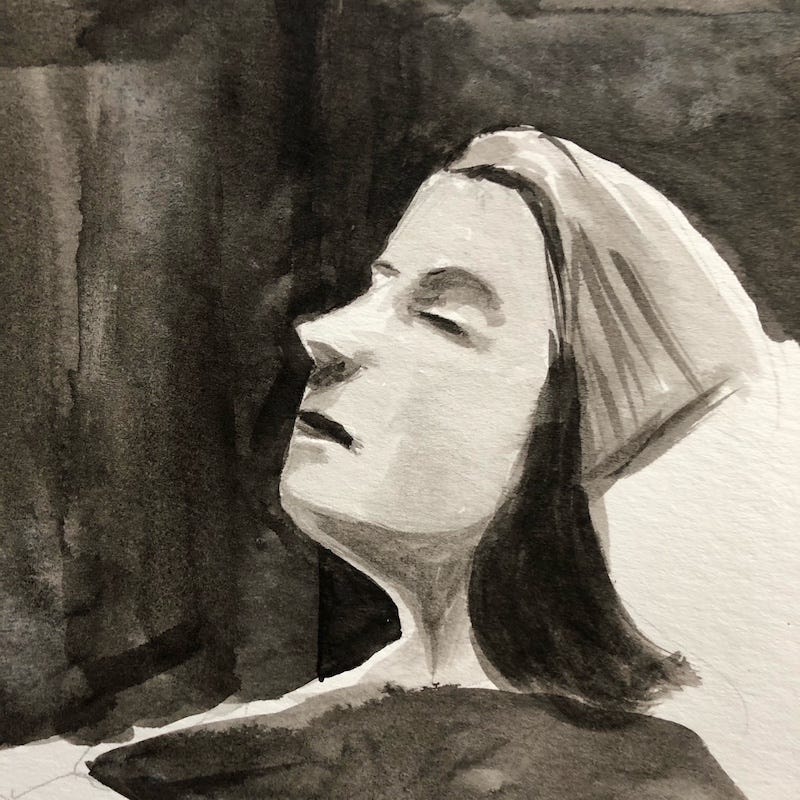
Thinking of Philip Caputo who died last week at the age of 84. Cancer. Caputo was a wonderful writer and fearless journalist best known for his 1977 memoir, A Rumor of War, which details his sobering experiences as a Marine in the early days of the Vietnam War.
According to a lovely obituary from his family:
He also shared a Pulitzer Prize at the Chicago Tribune for investigative reporting of Mayor Richard Daley’s infamous voting fraud in 1972. As a foreign correspondent for the paper, Caputo covered wars from Africa to Afghanistan to the Middle East, where he was captured and held hostage by Palestinian militants. In 1975, he was shot in Beirut by another faction of militants during Lebanon’s civil war.
“It was a simple malady in my boyhood, easily diagnosed,” he wrote in his second memoir, Means of Escape. “I wanted to wander the great world.”
In the fall of 2017, A Rumor of War celebrated its 40th anniversary with a new printing, and I was lucky enough to interview Caputo. This was around the time The Vietnam War documentary series, directed by Ken Burns and Lynn Novick, aired. I was already familiar with some of Caputo’s magazine reportage but I’d never read the book for which he was best known.
I didn’t serve in the military and don’t come from a military family; I melted green Army soldiers as a kid, drew pictures of guns and swords, and was once shot in the neck with a BB-gun for talking too loudly while playing war with friends in a damp field, knee-high in grass. I wasn’t tempted by Sgt. Rock comics, G.I. Joe action figures, or the big books on war, though by high school I quickly made my way to Slaughterhouse Five and Catch-22. I trudged through the two books that most inspired Caputo—The Red Badge of Courage and Farewell to Arms—and was riveted by If I Die In a Combat Zone: Box Me Up and Ship Me Home by Tim O’Brien which I read shortly after seeing Platoon; it wasn’t until two decades later that I read O’Brien’s masterpiece, The Things They Carry.
“I guessed we believed in our own publicity—Asian guerrillas did not stand a chance against U.S. Marines—as we believe in all the myths created by that most articulate and elegant mythmaker, John Kennedy. If he was the King of Camelot, then we were his knights and Vietnam our crusade. There was nothing we could not do because we were Americans, and for the same reason, whatever we did was right.”—Philip Caputo, A Rumor of War.
Caputo was an officer in the first combat unit to be sent to Vietnam in early 1965 and faced a general court-martial before the end of the year—the charges were later dropped. Ten years later, working as a foreign correspondent for the Chicago Tribune, Caputo was in Vietnam during the “fall of Saigon,” a changed man and one of the last Americans to leave the country.
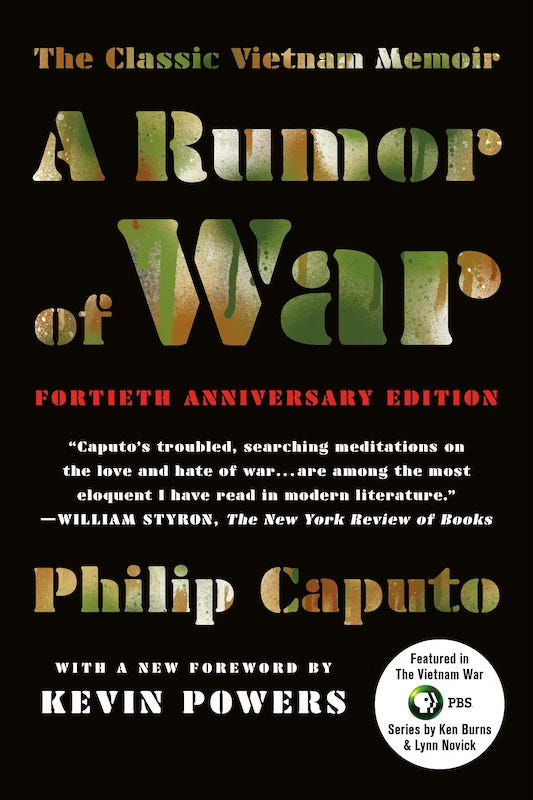
In an admiring New York Times review, Ted Solotaroff wrote, “Out of the force of his obsession with the war and his role in it, Caputo has revealed the broken idealism and suppressed agony of America’s involvement. A Rumor of War is the troubled conscience of America speaking passionately, truthfully, finally.”
“We lingered for several minutes, trying to make some sense out of it. The company had only done what it was expected to do and what it had been trained to do: it had killed the enemy. Everything we had learned in the Marine Corps told us to feel pride in that. Most of us did, but we could not understand why feelings of pity and guilt alloyed our pride. The answer was simple, though not apparent to us at the time: for all its intensity, our Marine training had not completely erased the years we had spent at home, at school, in church, learning that human life was precious and the taking of it wrong. The drill field and our first two months in Vietnam had dulled, but not deadened, our sensibilities. We retained a capacity for remorse and had not yet reached the stage of moral and emotional numbness.”—A Rumor of War
How do you read something so powerful and then talk to its author without sounding like a sucker? Especially when you haven’t served.
Well, Caputo didn’t suffer fools but he was warm and generous with me as you’ll see in these highlights from our conversation (here’s the full interview).
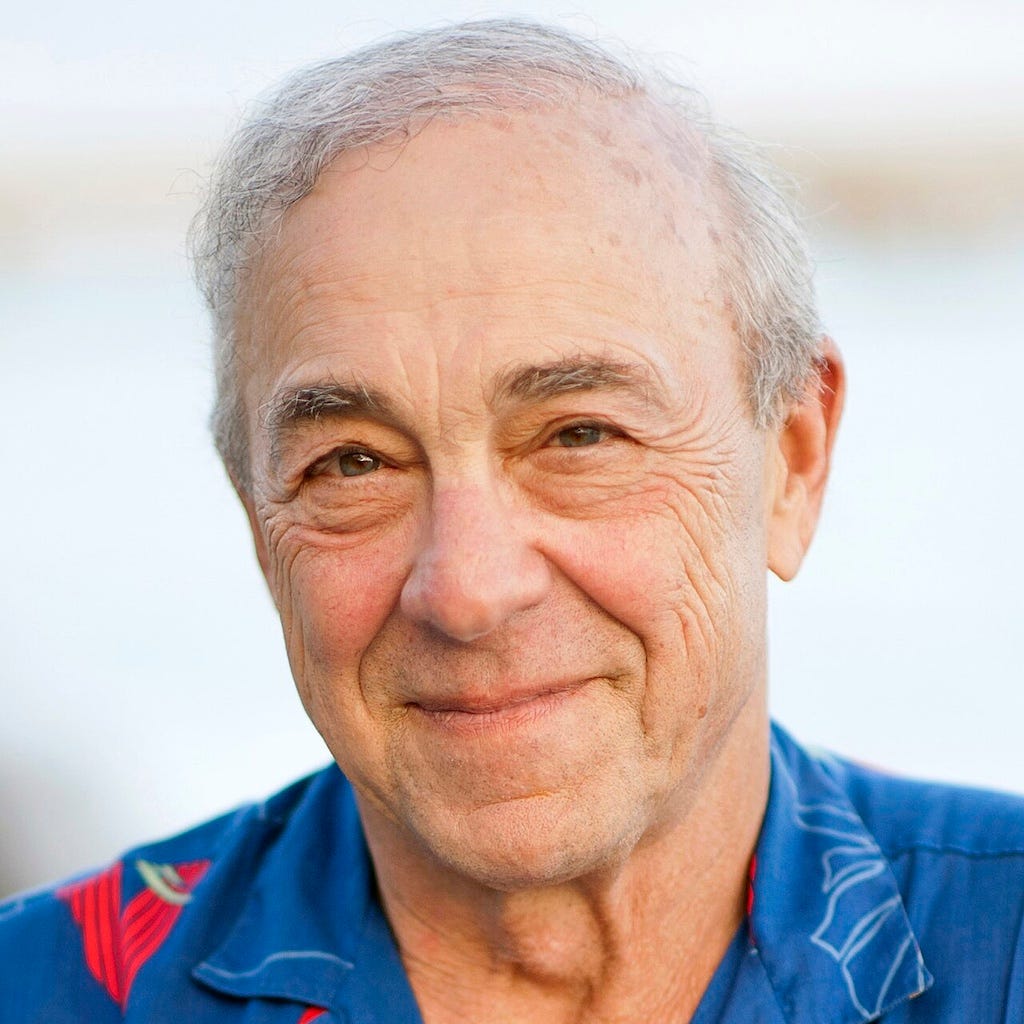
Philip Caputo: It’s interesting—to me, anyway, if you compare me to say, Tim O’Brien, who is 5 or 6 years younger than I am. Now that doesn’t sound like much, but in fact it is. By the time Tim came along the war had been going on for a long time, everybody kind of knew it was absurd. There was a sense of the absurdity of it. But when I went in I was steeped in the literary mythology of World War II and Korea, but especially World War II—James Jones and Norman Mailer, Irwin Shaw too. And I wasn’t as in love with the second generation of World War II writers like Kurt Vonnegut or Joe Heller. I’d read those but they didn’t quite resonate with me the way the other ones did.
I was trying to tell this classic kind of war story in a very unclassical war. I couldn’t make sense of it to myself. I said, okay, we go out on patrol and bang, bang, bang, this happens or nothing happens and we go back. And then we go over the same ground again. And absolutely zero is accomplished. Nothing happens. There’s no movement in the event you’re describing from point A to point B to point C towards some conclusion, as in James Jones’ Thin Red Line, which is the Battle of Guadalcanal or Mailer’s The Naked and the Dead, which is the battle in the Philippines. Those events actually moved from one point to another point and then you’re characters and your narrative move with it.
In this case, there was no external narrative, probably if I had been somewhat younger I would have been able to do something more experimental with it but I wasn’t able to. I couldn’t figure out, what’s the fucking story here? I was in Rome at the time. This would have been about ’72-’73 and I was trying to read Dante in the original Florentine Italian with the help of a translation and while I was reading it, it occurred to me the journey that Dante takes: he’s in the light and then he plunges into Hell and then emerges into purgatory and then finally into heaven so that he goes from a kind of false light into utter darkness and then emerges into a new and truer light. And I said, That’s the story. Because that’s what happened to me personally but I knew it had to be written in such a way that it would resonate with everybody. That everybody probably experienced what I did to a degree or another and that’s how I came up with the structure. So it had to be chronological.
Alex Belth: It was really humbling reading A Rumor of War. I don’t know how else to put it but it scared the shit out of me.
PC: This might sound strange but I’m actually glad it did because I wrote it with the view in mind of recreating the experience as much as I could on the printed page so that a reader would experience the war almost as if they’d been in it.
AB: How did you adjust to civilian life?
PC: [Laughs] With great difficulty. It’s the same story—you’re hearing it now from all the guys that have been in Iraq and Afghanistan. I don’t personally know any of my old buddies who made a smooth transition back into civilian life. And for that matter the only people I know who ever did were many of the World War II veterans. And I don’t know how smooth that transition was either because that war and that generation are now so marinated in mythology that it’s hard to say. They probably felt the same sense of dislocation that we did but it was not as severe because WWII was the great crusade, they were victorious, everybody loved them.
The unraveling that I experienced—that a lot of people experienced—much earlier in the war than many people think, was due to our immediate foxhole experiences. But once I got back and began to follow the war on TV and in the press I began to see this enormous con game—I can’t think of any other word for it—that government and the military was foisting on the American people, especially on the young men of my generation, and even worse, the young men of my generation who weren’t particularly economically or intellectually privileged.
AB: You survived the war and yet as a correspondent you ended up in combat situations time and time again—Beirut, Afghanistan—putting yourself in great danger. You write about the addictive nature of combat, but was there something even deeper going on in terms of tempting fate?
PC: I needed to be back in those situations, to make sense of why I had survived and others did not. That there was some meaning to why I lived. I went back into those situations because if I made it out alive it was a sign that I was somehow blessed or forgiven. It’s a little hard to express. Maybe a sign that God was looking on you with favor, after all.
AB: Were you looking for absolution?
PC: I’d say so, yeah, absolutely. Sixteen of the guys that I served with that I knew—I wasn’t close buddies with all of them but with maybe three or four of them—talked to, led them—are on the wall in Washington. So I went through that business of Why did I survive and they didn’t? You do feel a certain—they use the term “Survivor’s Guilt” but that doesn’t quite adequately express it though I can’t think of a substitute for it.
In Vietnam, I had betrayed the best image I had of myself. I was not only a killer but I liked it. There was this darkness in me that was very difficult to accept as part of my own nature. By exposing myself over and over to these situations, I trying to come to terms with that. I was trying to duplicate, if possible, some of the experiences I had in Vietnam with the hopes that I would behave with more nobility—better than I had before.
AB: And was that the case?
PJ: Not really, unfortunately, because in all these other wars I was a correspondent and although I was in danger of being shot at I could always get out of it. There was always the awareness that if I got through a particular firefight or artillery shelling, I could get out. So you couldn’t quite duplicate the circumstances of being a solider. The story I did for Esquire going into Afghanistan in 1979 was different. At one point the Mujahadeen gave me a rifle and said, “Sorry, we can’t guarantee your safety anymore, you’re going to have to take care of yourself, buddy.” So I was kind of a combatant at that point although I never shot at anybody, thank God. They gave me this old Lee Enfield 303 from Kipling’s day and we had to run through this gap in the Russian lines and I was just praying to myself, God forbid I have to shoot some Russian kid just to save my life. But that never happened.
AB: What were the consequences of your need to put yourself in danger? How did it effect your wife and your children?
PC: It was harmful to relationships. It wasn’t healthy. It’s one of the reasons Leslie is my third wife. We’ve been married for nearly 30 years but before that I think a lot of stuff I did with myself and lived my life was harmful to the emotional relationships I had.
AB: You write about the heightened senses, almost a high, that comes with combat. Are there satisfactions in life that are less charged as combat that have touched you as deeply? Things that are more mundane?
PC: Oh. I even had them when I immediately came back from the war because one of the things you always dream about is, Gee, wouldn’t it be great if I could lie in bed and have a cup of coffee. But falling in love comes close to the intensity of the experience of war. Of course, it’s quite different. Just looking at the face of somebody you really love, even as time goes by, one derives just great joy and satisfaction from that. I guess the emotional intensity is of a different order though.
AB: I know you said you had certain literary ambitions for A Rumor of War but I’ve also read that when the book came out and was a success the sudden fame that came your way was really disconcerting. How did you deal with all of that?
PC: That was really hard. It ambushed me. First of all, I finished the book and had got a $6,000 advance. I told my first wife Jill, I hope the book does well enough to earn out the advance and maybe we’ll make enough money to go on a real neat vacation together. I was even planning it, we were going to go to Greece. So when all of a sudden the book turned out to be a sensation I had a lot of trouble dealing with that. It was kind of weird. It wasn’t like I was a child. I was 35, something like that. I’d been a journalist so I’d been out in the world. Looking back on it, some part of me felt that I was now exploiting this experience. And in the exploitation I was betraying my old comrades.
AB: Instead of paying homage which is what you were also trying to do.
PC: Yes, but a part of me definitely felt that way. A couple of times during the book tour I’d be asked these questions and they’d completely flabbergast me and I’d almost be mute about it. I was a journalist but I was a print journalist. Now I’m on these talk shows and morning shows and there’s all these slick TV people moving around and I was supposed to somehow express this profound experience in 3 minutes. On demand. It was pissing me off but I felt guilty about being a sort of celebrity, I guess.
AB: Did you ever talk about that with writers like Michael Herr or Tim O’Brien?
PC: No. I’ve had long conversations with both of them, especially with Tim but I can’t say I ever discussed that with them. Nor did they ever express that to me. So I don’t know if they felt that way—we’ll never know about Michael because he’s gone now.
AB: You are in a small and special fraternity of writers associated with Vietnam.
PC: Yeah, I think we’re—for better and worse—a brotherhood of sorts. You’re forever marked by that, both by the experience of war and then the subsequent book. I remember an essay ages ago by John Knowles, who wrote A Separate Peace. That’s all he was ever known for even though he wrote a lot after that. He talked about the strange blessing of having your first book become a classic but at the same time it is a burden, a curse. Joe Heller told me that in so many words. He was always trying to write himself away from Catch-22. Gloria Jones mentioned that explicitly to me about Jim Jones. Everybody would run into Jim, having read From Here to Eternity and say, “I read your book.” And Jones would have to say, “Which one?” Knowing what they meant.
AB: Forty years later what is it like to revisit A Rumor of War?
PC: I’ve never re-read it cover to cover but have read pieces from it for many years when I’ve been asked. I have this weird feeling that somebody else wrote it. In a way, like my wife says, somebody else did. You were 35 when it was published and you started it when you were 26. So in a way it was written by somebody else.
EC: Do you feel that not only did somebody else write it but the character on the page is also somebody else?
PC: No. I still feel close that person in a way that I don’t to me in college or me in high school. I don’t know how many times I’ve gotten letters or emails or comments on my website or my wife will mention, Do you remember we went here or met this person or we did this? And I don’t remember. Whereas I can remember everything about myself in Vietnam at that time very clearly.
AB: I don’t mean to be corny but do you feel as if you are more at peace with yourself as an older person?
PC: Oh yeah. I can’t remember where I heard this but you assuming you have reasonable degree of health that you tend to get happier as you get older and that’s certainly been my case.
AB: Happier because you are grateful to have the things you have?
PC: Yes. You’re worried your question was corny, I’m worried my answers are. [Laughs] I wake up in the morning and notice the way the light falls on the trees. Sometimes I’ll look at my two dogs, like I’m doing right now. They’re lying on the rug in my office. [Laughs] I just feel this joy in looking at them. Sometimes, I don’t want to get mushy about this, but I tend to wake up before Leslie does, and I love to look at her sleeping. Just the way her face looks. There’s a kind of serenity about her. All those small things mean so much more to you when you’re older and you’ve come to terms with your own limitations. Even when I was middle aged I could be a real hard ass. A pain in the ass sometimes. Stuff now that I know would have bugged me when I was 40, 45, that just rolls off my back. You mellow out. If you have work you love, and a Love you love, that’s it.
Not long after we spoke, I ran into Caputo and his wife Leslie at a fancy Lincoln Center screening for the Vietnam documentary. We were chatting amiably at cocktail hour before taking our seats, and it was clear that Caputo and his wife loved each other and were pleased to be in each other’s company. Before long, a power broker friend joined us and dropped dinner plans to which I was not invited. I didn’t expect to be included so I wasn’t offended but I could see that Caputo registered the potential awkwardness of the situation.
When I emailed him about it the next day I thanked Caputo for his sensitivity. He replied that he didn’t think he was so sensitive, though he clocked what transpired.
I didn’t know Caputo, and perhaps he wasn’t sensitive, certainly not always, or maybe his qualities of perception and awareness run deeper than just sensitivity. I was grateful to speak with him and learn more about someone who has seen things and done things I can only imagine. I also wake up before my wife, look at her sleeping beside me, and know exactly what it means.