
Under A Christmas Moon
Celebrating Lee Friedlander, David Bowie, and My Stepfather, Tom

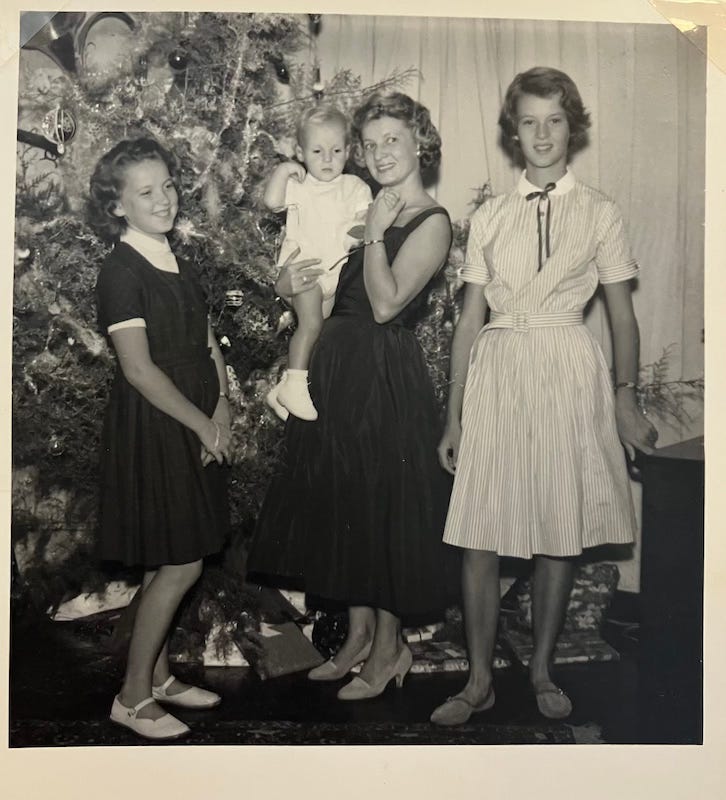
My mother arrived in this country in April of 1967 having just turned 23, wearing a pale yellow Courrege pant suit, navy blue sandals and a French trench coat. Six months later, in my grandparent’s apartment on 81rst Street between Columbus and Central Park West, she and my father were married.
She did not bring much with her from Europe, making each item—a blouse or a bracelet—feel like treasure. A hastily assembled photo album became for us kids, her visual autobiography, made even more alluring because the Bertrand’s spoke French, and Swahili, and only broken English. I was captivated by the black-and white pictures of their Christmas’s in the Congo, cypress tree instead of pine, featuring candles, attached to outer branches with a clip, illuminating the tree.
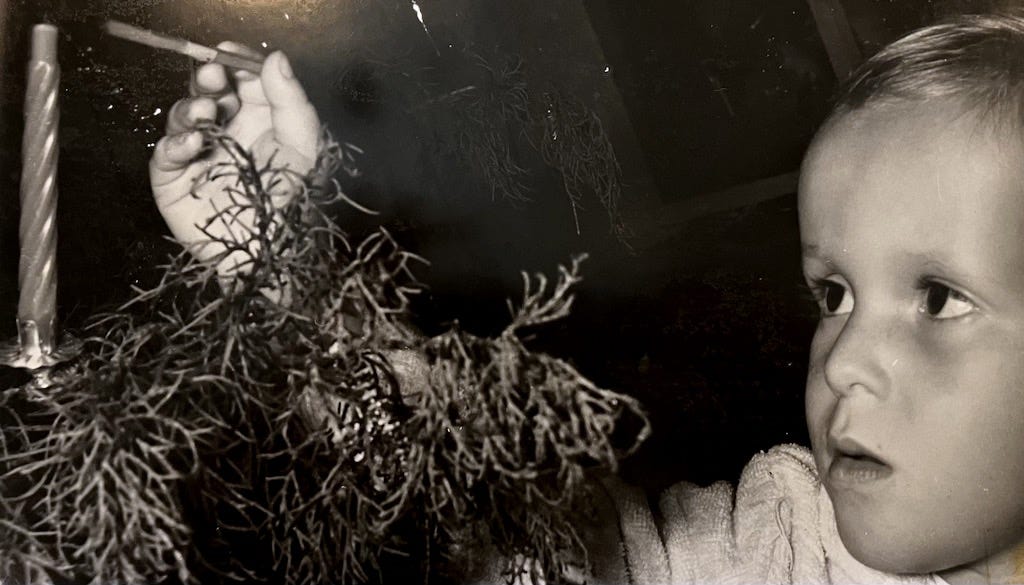
Christmas proved a thorny issue since my mother had married into a Jewish family that did not celebrate. My father barely tolerated it, and wouldn’t permit lights on our tree, so we used tinsel—in moderation—and popcorn on a string that we made from scratch. He didn’t believe in Santa Claus so neither did I. But I liked Christmas, the annual TV cartoons—Frosty the Snowman and Rudolf and The Grinch. Mom played Handel’s Messiah on Christmas Eve, and we wore out our copy of The Muppets Christmas with John Denver. She even took us to midnight mass one year at the old church a mile away on Baptist Church Road, the sole time she ever brought us to a house of worship.
Near the end of their marriage, Dad relented and we were allowed lights—but only small white lights, not the big multi-colored bulbs. This was the year my parents decided to put all the presents under the tree a week before Christmas.
There were not a lot of gifts, but there they were, every hour of every day, daring me not to open them. In the end, at age eight, it proved too tempting and I caved.
One morning, I snuck downstairs before anyone was awake, and carefully—as I watched Mom open her wrapped presents, with the intention of saving the paper to use again (such a shame to go to waste)—pulled the scotch tape back and peeked inside. I saw my gift—a baseball mitt without a major leaguer’s autograph—and then I opened my brother and sister’s gifts, the Popeye soundtrack album and a Pretty Changes Barbie.
I rewrapped the presents, hoping the tape still adhered (it didn’t). Then I went upstairs and woke up my sister and brother and told them what they got.
1980. The year I ruined Christmas.
Not long after, Tom, the man who would become my stepfather, and his two kids became part of our holiday. They contributed Johnny Cash: The Classic Christmas Album to the rotation, adding some ironic amusement to the proceedings, as did their endurance of John Denver and the Muppets. The first Christmas we spent together was at his home in 1983—three years later, we would be living there as well. I was nervous and stressed twelve-year-old kid who placed high expectations on gifts, as proof that I was worthy of love.
Tom and I didn’t have much in common, anything really. The idea that he might be, if not a replacement to my father, then perhaps a viable alternative, was still in the offing. The one sport Tom seemed to know about—hockey—is one I didn’t like at all. A small pond, already iced over across the street from his home, inviting to any kid who liked to lace ’em up. I never took to skating, though and didn’t hang with kids who did.
Christmas morning, and what do I get from Tom but a hockey stick. Unable to hide my dismay around these strangers I thought—how could this man so misunderstand me? I wouldn’t let it go, though the bitterness morphed into something more like shame. Shame at having been so callous to him, embarrassing myself in front of my new siblings and my family, a shame that until recently left little room for compassion for my twelve-year-old self.
Meeting Tom and his family coincided with my David Bowie phase, an obsession that lasted a good few years. One of my prized possessions from that time is a picture book of Bowie’s Serious Moonlight world tour. It captured Bowie on stage, the striking ’80s power pop version of the thin white duke, with his svelte build and baggy pants, utterly sophisticated even with the tweety-bird yellow hair. There are also plenty of candid shots of Bowie backstage, too, between shows, in the Far East, Australia, and other distant ports of call.
I still have my copy but until I read through an old journal recently didn’t realize where I’d gotten it—from Tom, who is still married to my mother close to forty years later.
I understand that on a somatic, nervous-system-level we retain negative information more than affirming information, so I can appreciate why I recall the hockey stick incident, particular the echoes of guilt. But why did I not remember that this man also bought me a book I’ve loved ever since?
How does an act of generosity like that go unremembered?
When we first moved into Tom’s house on the corner of Colabaugh Pond and Mt. Airy, there was a makeshift darkroom set up in the master bathroom. He was an amateur photographer and although he no longer used the darkroom it held the promise of a connection that never materialized. Tom had a good eye and a nice, but not fancy, Nikon 35mm camera. He didn’t order prints but slides of his photographs which he projected on a screen in the living room.
He was a different kind of man, having spent seven years in the Coast Guard, stationed mostly in Hawaii, touring the Pacific. He owned a boat ever since. In the ’80s, he had a 26-foot double ender with bunks and a kitchenette that he sailed on the Connecticut Sound on weekends during the summer (I went only once). He sewed quilts, and made three dulcimers by hand, each taking months of exacting work to complete. He also built his house by himself. It took a year to complete, while he and the family lived in a makeshift shack on the property. If I couldn’t relate to his interests, I watched him proceed with stoic enthusiasm, discipline, and patience.
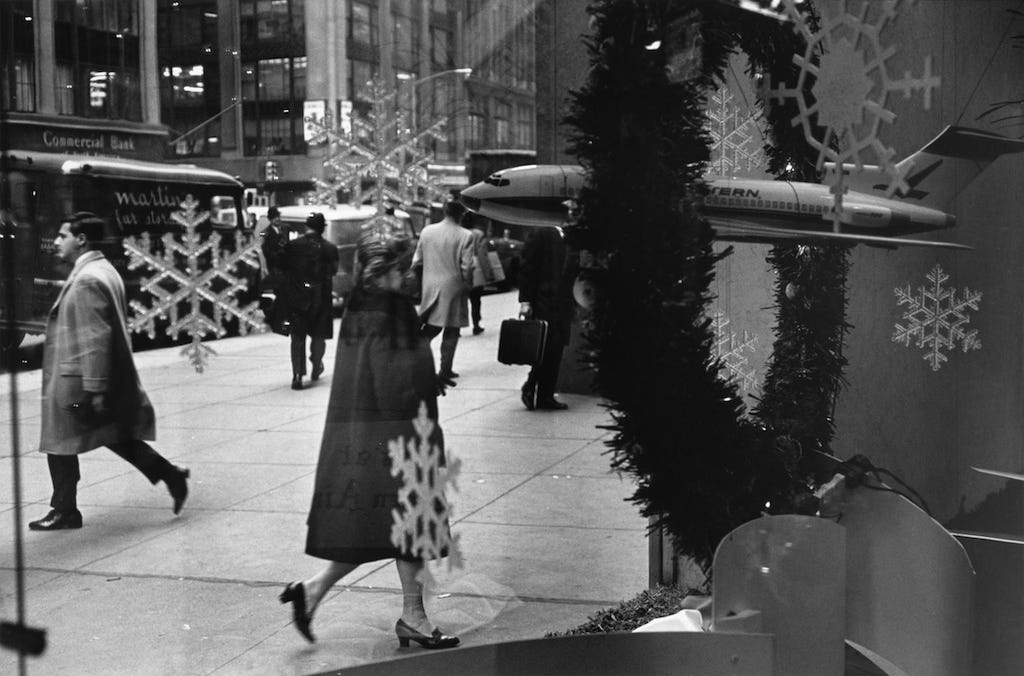
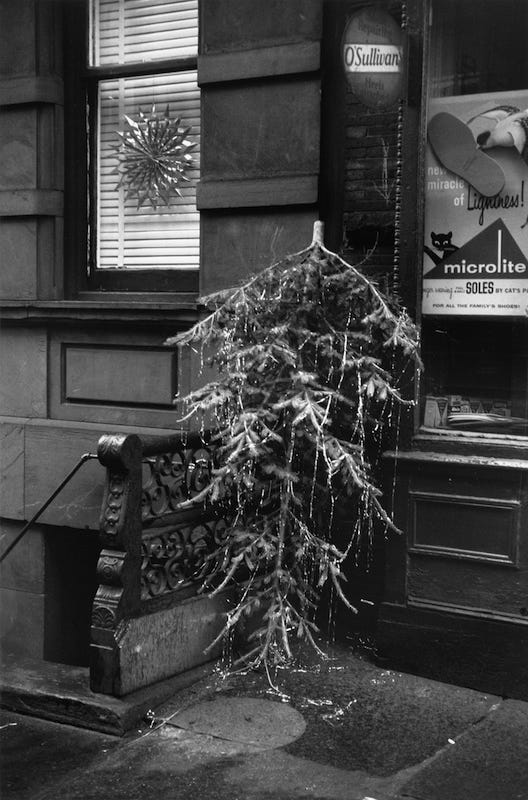
Last week, I was remembering the way Tom worked, as I’ve poured over Lee Friedlander: Christmas, a new monograph featuring Christmas-related pictures taken over a seventy-year span. This is another happy collaboration between Friedlander and the Eakins Press Foundation, run by Peter Kayafas, a photographer who, as a child met Friedlander, and has been working with him for the past decade.
“Lee is notoriously laconic, to put it gently,” Kayafas told me in conversation this week. “He often says, ‘Why would I want to do an interview?’ ‘Why would I want to talk about my photographs, that’s for somebody else to do, I’ve already done my work.’ And work is the operative word. He thinks of what he does as work. It’s work that he delights in but it’s work.”
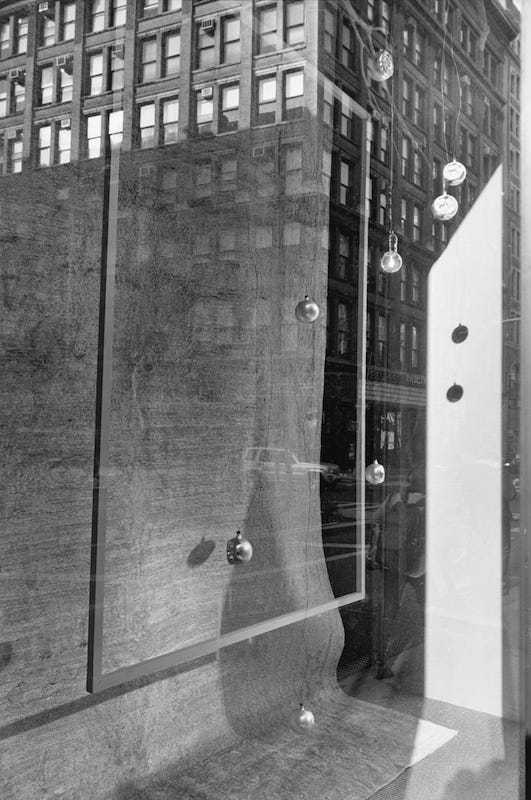
“He thinks of his job as paying attention to the world,” Kayafas continues. “Here’s another part he doesn’t talk a lot about. Knowing when to press the button, when to release the shutter, and also knowing how to edit, how to put things together in groups, and how to surround himself with other people with whom he has a kind of affinity and a synergy. I’m happy and privileged to think of myself as one of those people for the last ten years or so.”
The Christmas monograph is not overly long or overwhelmingly dense, its narrative more musical than novelistic. I love how the pictures are not arranged chronologically, creating a different sense of time, with Friedlander’s vision the continuity between decades.
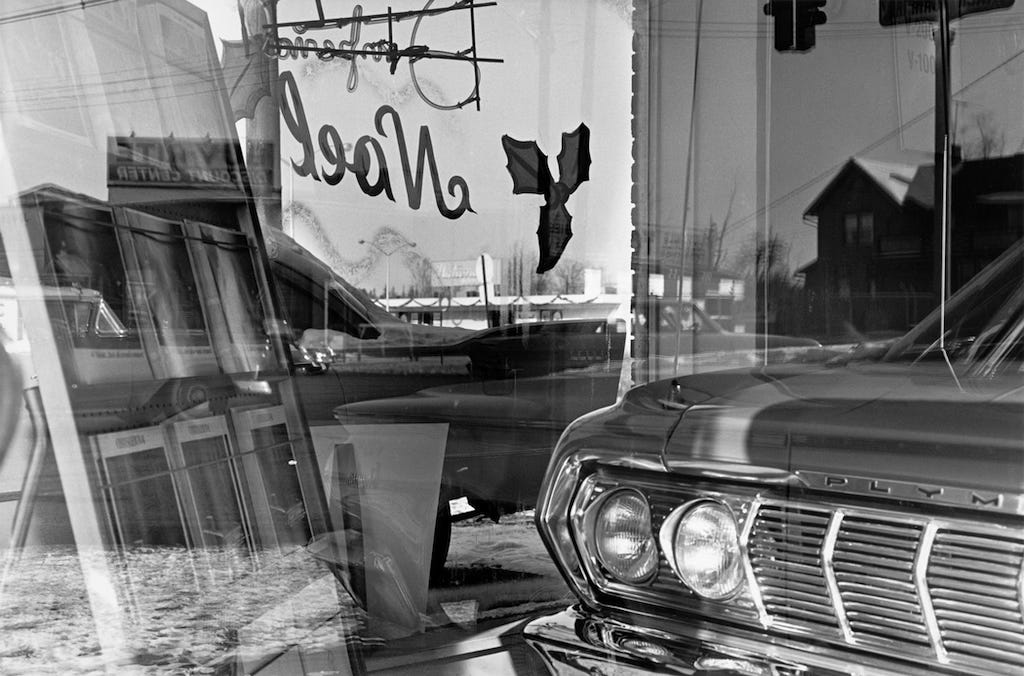
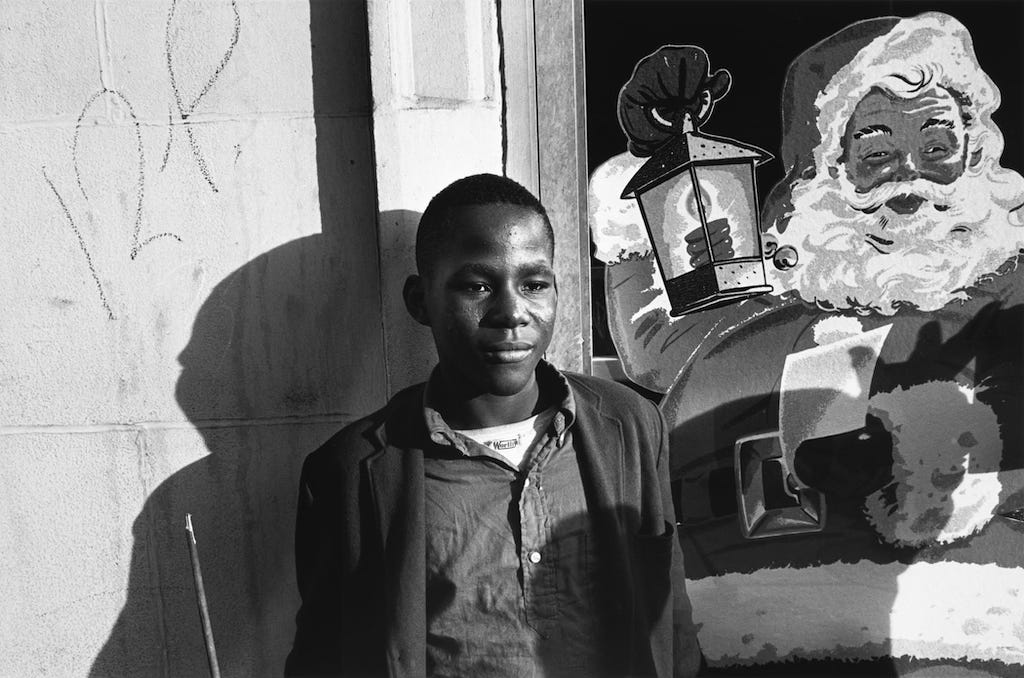
“Photography shows us not just what happened at that time,” Kayafas says, “but what happened since.”
Much has changed in America over those seventy years but our relationship to Christmas remains steadfast. “Nostalgia and sentimentality and a certain melancholy is built into American culture, whether it’s a commercial level or a communal, ritualistic level,” says Kayafas. “Certainly, it’s distilled with Christmas, when it becomes more flagrantly ironic. There’s nothing innocent about Christmas other than its irony.”
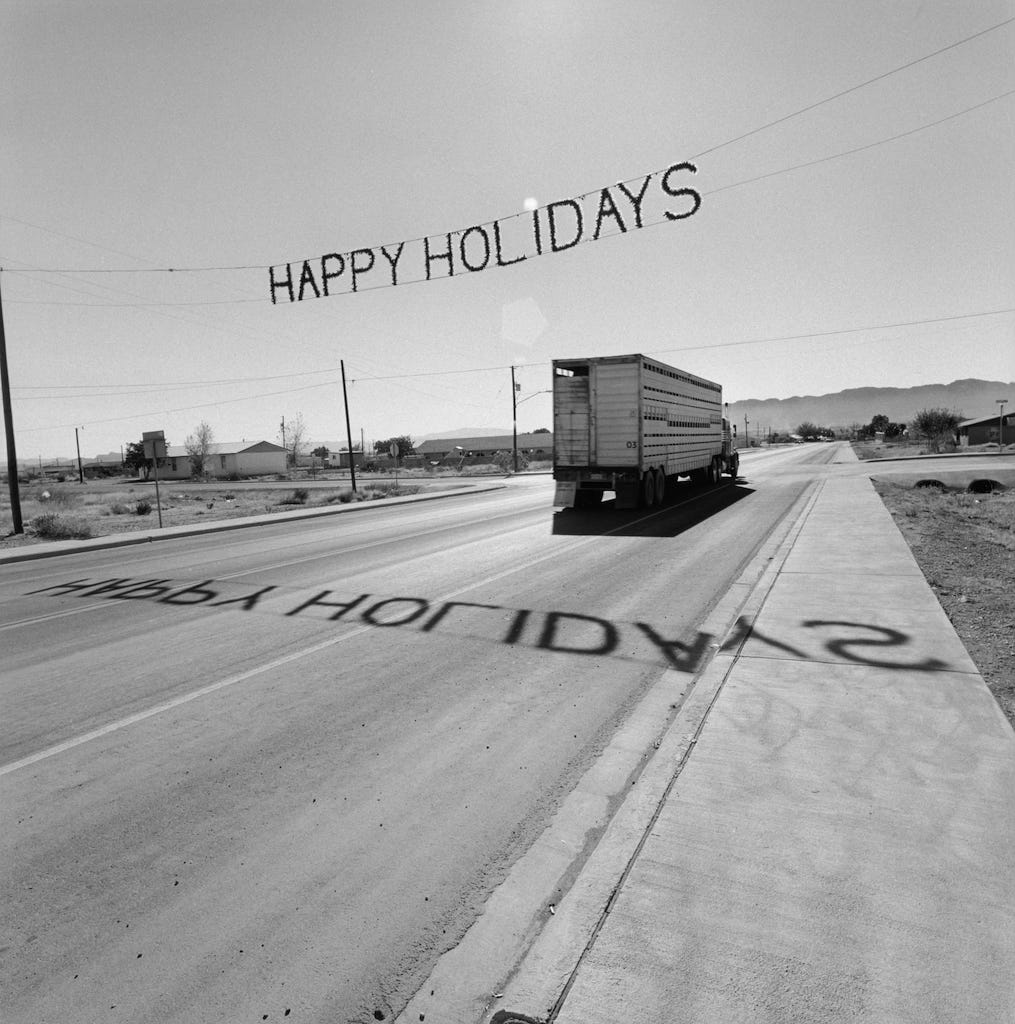
The irony may be unavoidable, as we see in these pictures, but irony not Friedlander’s subject. “Lee thinks of himself as an anti-intellectual,” Kayafas says, though he believes Friedlander is being coy. Because it’s so obviously not true. “He is an intellectual,” says Kayafas, “it’s just that his intellect manifests itself is in the rectangle. Consistently.”
Photography is a generous medium, Kayafas tells me more than once. If you were blindfolded and walked down the street with a camera and told to press the button every ten seconds, you’re likely going to wind up with an interesting image in a roll of 36 exposures. That’s how it happens. “But the consistency of Lee’s manifestation of his talent,” says Kayafas, “his intellect, in that rectangle, for over 70 years, is frankly shocking. Or maybe it’s awesome, because it’s a slowly accumulated shock.”
Kayafas calls Friedlander “an intellectual poet,” knowing that Friedlander would bristle at the notion because he thinks of himself as neither. He thinks of himself as a working photographer. And that’s what interests him—his work.
A few years ago, my mother and I were talking in her vegetable garden as she dug in the dirt and pulled out fingerling potatoes. Pleased with the bounty she wiped her brow and said that she still sometimes gets anxious at night, lying in bed awake. “That’s why I’m so lucky that Tom is there,” she said.
She is now 81 years old. He is 88.
I asked her what he says at those moments.
“Oh, he doesn’t say anything, he’s asleep,” she said.
Ever since that moment, I’ve been grateful for Tom, a man with whom I do not have much in common except what matters most—loving my Ma. Gratitude too for what he’s taught me about being a loving partner: presence can be everything.
As a child, the world is without limits. Long ago, Tom and my mother were just learning the patterns of their new life together. And on the night before Christmas 1983 Tom put a bow on a wooden Koho hockey stick in the hopes that it would make me happy. A year later, he carefully wrapped a David Bowie picture book. There were lights on the tree and some tinsel, too.
I did not yet know how long this relationship would last or what it would mean for me; I was still pissed about the hockey stick and prepared myself for another letdown. We went to sleep that night in the brown cedar house with a white front door that Tom spent a year building by hand, across from the pond that would only sometimes freeze, each of us with the knowledge that we would soon wake to a new Christmas.
[Photo Credits: photographs by © Lee Friedlander/Fraenkel Gallery, courtesy Eakins Press Foundation, and featured in Lee Friedlander: Christmas; other two images courtesy Bertrand family archive.]
Most beautiful Christmas reading … thank you!