

In some ways, Tom Junod has been writing his father’s story forever. Much of Tom’s new memoir, In the Days of My Youth I Was Told What It Means to Be a Man, however, takes place over the past decade, where the author, in search of the truth about his father, finds the real story.
Lou Junod won a Purple Heart during WWII and crooned in the Frank Sinatra style, a man of such physical beauty and personal charm he could barely walk down a block in Manhattan without being propositioned. He made his living as a handbag salesman and everything he did was touched with a certain brand of mid-century masculine glamour. Still, deceit lurked—gambling, adultery, and worse.
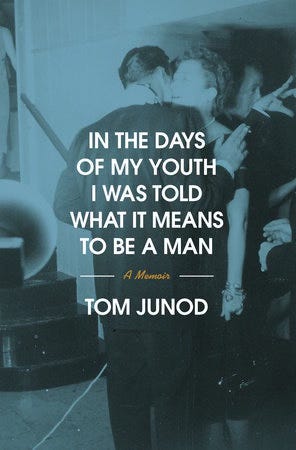
Among other things, this memoir is a meditation on the helplessness of a child before a charismatic parent. Junod writes:
“As much as I enjoyed his stories, I also needed them. They were all I had of him—all I had of his youth, all I had of his ‘formative years,’ all I had to go on when I was trying to figure out why he was the way he was, even though they never answered the question. They weren’t lies; they weren’t even tall tales. But I never had the sense that my father was telling the whole and hard truth about how he grew up until we asked him about his own father. Then he gave us an answer he repeated without variation over the years, an answer that came as close as he ever could to explaining himself.
‘I never had a father.’”
Junod has covered the waterfront when it comes to Big Lou. Indirectly at first, in the GQ stories “Frank Sinatra Jr. is Worth Six Buddy Greco’s” and “The Last Swinger,” and then head-on in the affectionate tribute, “My Father’s Fashion Tips.” Later, at Esquire, he wrote about his father’s time in the military during WWII, and Big Lou’s shot at show business stardom:
“Throughout his life, he got in the habit of taking the stage at weddings and in nightclubs, when he was so intoxicated with the fact of being Lou Junod that he just had to sing about it, but he never got paid for his efforts. He never became a professional singer. He never became a big star.
“Was he unlucky? He was unlucky to define stardom as a matter of luck, and so to be at its mercy. But he was lucky in other ways. In 1947, he married my mother, the former Frances Brandshagen, the belle of Brooklyn. In 1948, my brother and sister were born. Ten years later, so was I. We all live now within a few miles of one another, outside Atlanta. My mother has returned to health, and my father is still alive. My family is still alive. Although my father does not live in the way a star might live, he lives in the way a father might live, and so should consider himself a lucky man. He does. He doesn’t. And to the degree he does, that’s the degree he’s had to give up his older, bolder dreams. Indeed, if my father has any luck at all, it’s that he’s lived long enough to accept the kind of luck usually allotted to lesser men.”
Even more recently, Junod wrote about his father’s gambling for ESPN:
“Everybody thought Lou Junod was a gangster. He not only looked the part, with his pinkie ring and French cuffs and blue dress shirts white at the collar, he played it, cultivating an air of danger. He had beautiful manners and always strove to be a gentleman, the striving itself a part of his charm. But there was something feral about him behind the civility, the elaborate coded masculinity and even more elaborate actorly diction. He chased down men when they cut him off in traffic and got into fistfights well into his 70s, his anger an eclipse you couldn't help but look at even though you knew it would strike you blind. He had an underworld glamour, even to his own children, and a reputation. People figured he had "connections," and he did -- his connections called our house, like old friends. But they weren't friends. They were bookies, and they had him by the balls.”
I’m a sucker for memoirs about fathers—The Duke of Deception by Geoffrey Wolff, Notes on a Cowardly Lion by John Lahr, and Half the Way Home by Adam Hochschild come to mind—even stories about fathers who are not there, such as Little Boy Blues by Malcolm Jones or After Visiting Friends by Michael Hainey. I also love memoirs about family secrets—Hons and Rebels by Jessica Mitford, The Hare with Amber Eyes by Edmund de Waal, and The Architect of Desire by Suzanne Lessard. Junod’s book is a doozy of a father-son portrait. Secrets are revealed, lives altered, in this big, generous tale; I love the portrait of the author’s mother, Frances, who was as grounded as Big Lou was celestial.
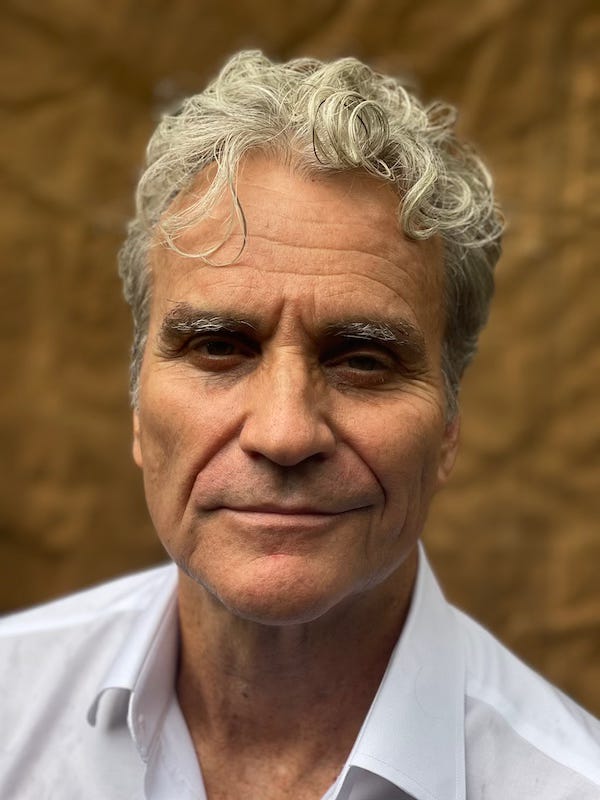
I’m pleased to have Tom join me in conversation this week to discuss In The Days of My Youth I Was Told What It Means to Be a Man, the project of a lifetime, what it took to write the book, and the complexities of being a Good Son.
Dig in.
[Photo of Lou Junod via Tom Junod; Portrait of Junod by Lee Crum]


