
Beginner’s Mind
What Giorgio Morandi, Marcella Hazan, Jhumpa Lahiri and Uncle Fred taught me about taste, restraint, and the pursuit of quality

My uncle Fred the painter didn’t like pop art. Comic books weren’t for him either, though he loved George Herriman’s Krazy Kat comic strip. Fred was a serious painter, and while he appreciated humor in all things, even painting, the seriousness with which he took art was something I never questioned.
My uncle took me to art galleries and the Modern and the MET—we saw shows by William King and Joseph Cornell, R.B. Kitaj, Marisol Escobar, Willem de Kooning, Francis Bacon and Lucien Freud, and also Caravaggio, John Singer Sargent, William Harnett and Giorgio Morandi.
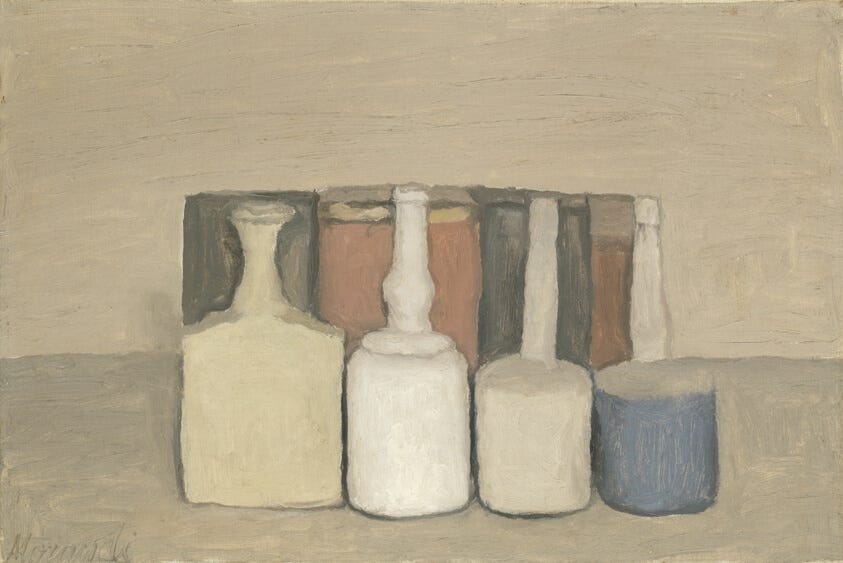
Some of these artists—Marisol, Cornell, Bacon—immediately appealed to me while other, like Morandi, whose catalogue raisonné is now available from The Morandi Museum in a lavish new volume, proved an acquired taste.
And adult taste—like tea or coffee or olives or beer.

As a teenager, my tastes were ever-changing but I preferred bold, vibrant artists and filmmakers and musicians.
It wouldn’t be for another couple of decades that restraint—in all things—became attractive. I didn’t get Willie Nelson until I was in my forties. I’ve learned so much watching Jacques Pepin, a master professional chef, who teaches us to took at home. His show is never about brilliance or technique—though he wrote a seminal book on kitchen technique—but about valuing the things that matter. Quality. And showing respect by not overdoing it.
I love this 2008 Atlantic interview with the novelist Jhumpa Lahiri:
One critic who reviewed your first book said that your prose is extremely un-self-conscious and not showy. Without making a judgment on that, do you think he was correct?
I like it to be plain. It appeals to me more. There’s form and there’s function and I have never been a fan of just form. My husband and I always have this argument because we go shopping for furniture and he always looks at chairs that are spectacular and beautiful and unusual, and I never want to get a chair if it isn’t comfortable. I don’t want to sit around and have my language just be beautiful. If you read Nabokov, who I love, the language is beautiful but it also makes the story and is an integral part of the story. Even now in my own work, I just want to get it less—get it plainer. When I rework things I try to get it as simple as I can.
Do you have any desire to write a huge, panoramic novel?
I don’t think so. I don’t think I’m an effusive writer. My writing tends not to expand but to contract. If I do write more novels, I think they’ll be more streamlined and concentrated.
That fits into what you were saying about your prose style, right?
Maybe. Yes. I don’t like excess. When a great sweeping work is great, what makes it great is that there’s no excess.
This apparent plainness explains much of Morandi’s appeal. (Also, Lahiri did write a huge panoramic novel, and her ability to push herself beyond her comfort is ridiculously admirable.)
I’m reminded of something that Pulitzer Prize-winning memoirist Yiyun Yi cited in a recent New Yorker interview:
What is the book you might, while writing, want open to any given page?
“The Collected Poems of Wallace Stevens.” The book sits on my right-hand side with my journal, so any time of the day I may reach for it and read a poem, or a stanza, or just a couple of lines on a random page. I’ve often returned to this stanza, which has a clarifying effect for my mind, and the phrase “acutest speech” speaks aptly of my aspiration in writing:
To say more than human things with human voice,
That cannot be; to say human things with more
Than human voice, that, also, cannot be;
To speak humanely from the height or from the depth
Of human things, that is acutest speech.
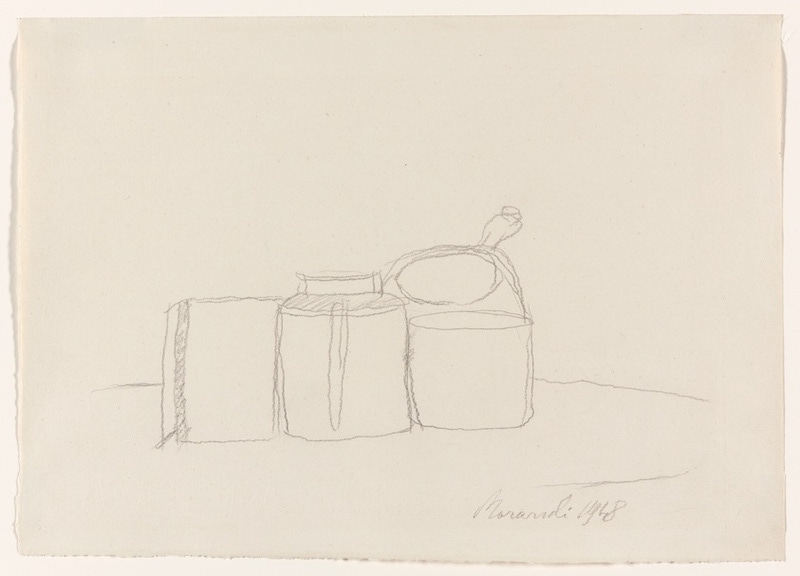
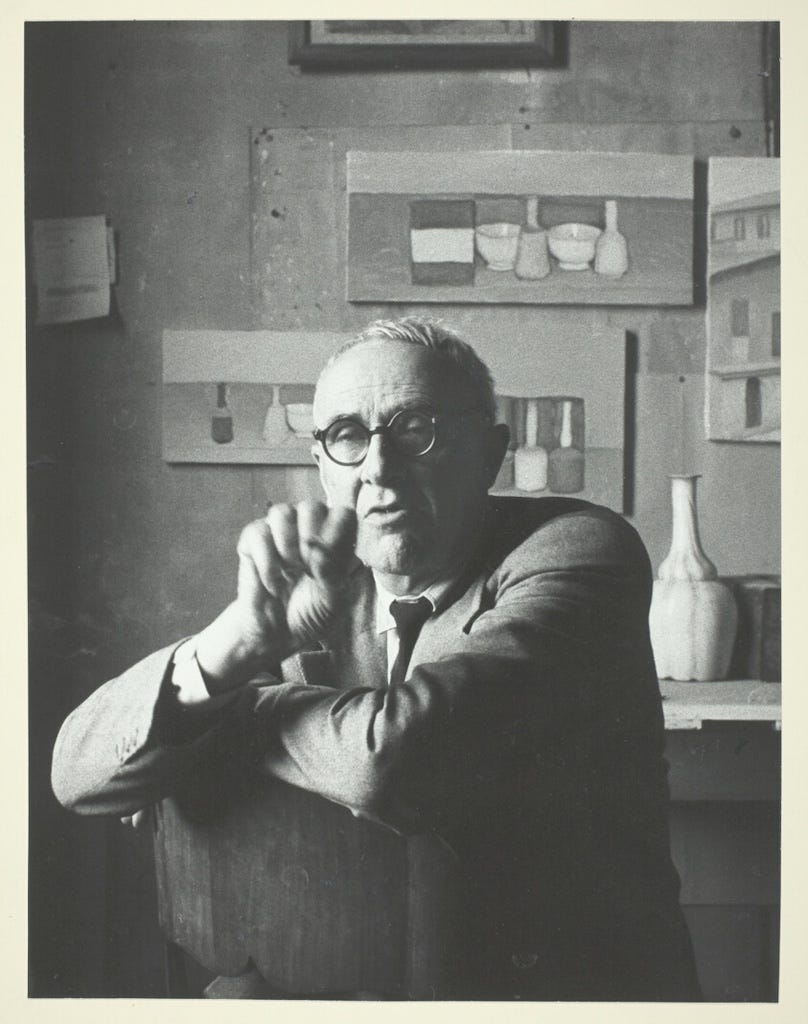
Uncle Fred revered Morandi’s still life painting and drawings and etchings. Here was an artist whose ambitions were humble.
Fred showed me many pictures of Morandi’s bottles, always closely arranged to each other.
At first glance, the pictures seemed simple to me.
Fred pointed out how Morandi always gives a path for your eyes to travel in his pictures, how the seemingly imperceptible spatial relationships between the objects create, for the viewer, a sense of believability—the bottles are never floating, they looked rooted.
We’re talking about the realism of space—and negative space—but Fred always saw Morandi pictures as essentially abstract. In 1955 Morandi said, “Nothing is more abstract than reality.” Three years later he said, “If I had been born 40 years later, I would have painted abstract paintings.”
What makes a great representational painting isn’t so different from what makes a great abstract picture. And when you’re talking to artists, they see the idioms as interchangeable.
Also, my uncle stressed that Morandi’s devotion to the still life didn’t make him a lesser artist but one that deserved special admiration.
At first, I didn’t like Morandi’s palette—all those earth tones, beiges, and browns. It wasn’t sexy or exciting. Not yet.
Neither was Marcella Hazan, the great Italian cook and teacher. A few years ago, I wrote about Hazan for Esquire:
“All that really matters in food is its flavor,” Hazan wrote in Marcella’s Italian Kitchen. “It matters not that it is novel, that it looks picture-pretty.… Do not strain for originality. It ought never to be a goal, but it can be a consequence of your intuitions. If the purpose of flavor is to arouse a special kind of emotion, that flavor must emerge from genuine feelings about the materials you are handling. What you are, you cook.”
Do not strain for originality. That Strunk and White directness seems like a total buzzkill at first. And yet the first Hazan recipe I tried—balsamic strawberries—taught me to shaddap and do as I was told.
About those strawberries: From Marcella’s Italian Kitchen, this is a radically simple, happy-accident sort of dish that Marcella concocted in an effort to spruce up out-of-season fruit. Wash two pounds of strawberries in cold water. Hull them and then slice them in half. Let them sit in four to six tablespoons of sugar for 20 minutes. Before serving them, splash them with a couple tablespoons of balsamic vinegar. Boom. The tart syrup makes the berries taste more like themselves but also something elevated.
This was not the Italian food I knew.
I like different things now than I did as a teenager. I don’t have much of a taste for many of the things that wowed me then.

What I learned about cooking from Marcella, or making pictures from Morandi, is that simplicity is not simple. Simplicity—or the appearance of it—could be the most difficult thing to master. But the pursuit is worthwhile because what we’re talking about is quality, value, things that last.
And what is a more precious commodity than the pursuit of quality in all things—what we eat, what we watch and listen to, who we hang out with, who we love. Who we are.
[Featured Image, Still Life 1955 via Art Institute of Chicago.]
Loved this article. I have one of Fred's paintings. It's filled with trees throughout.